


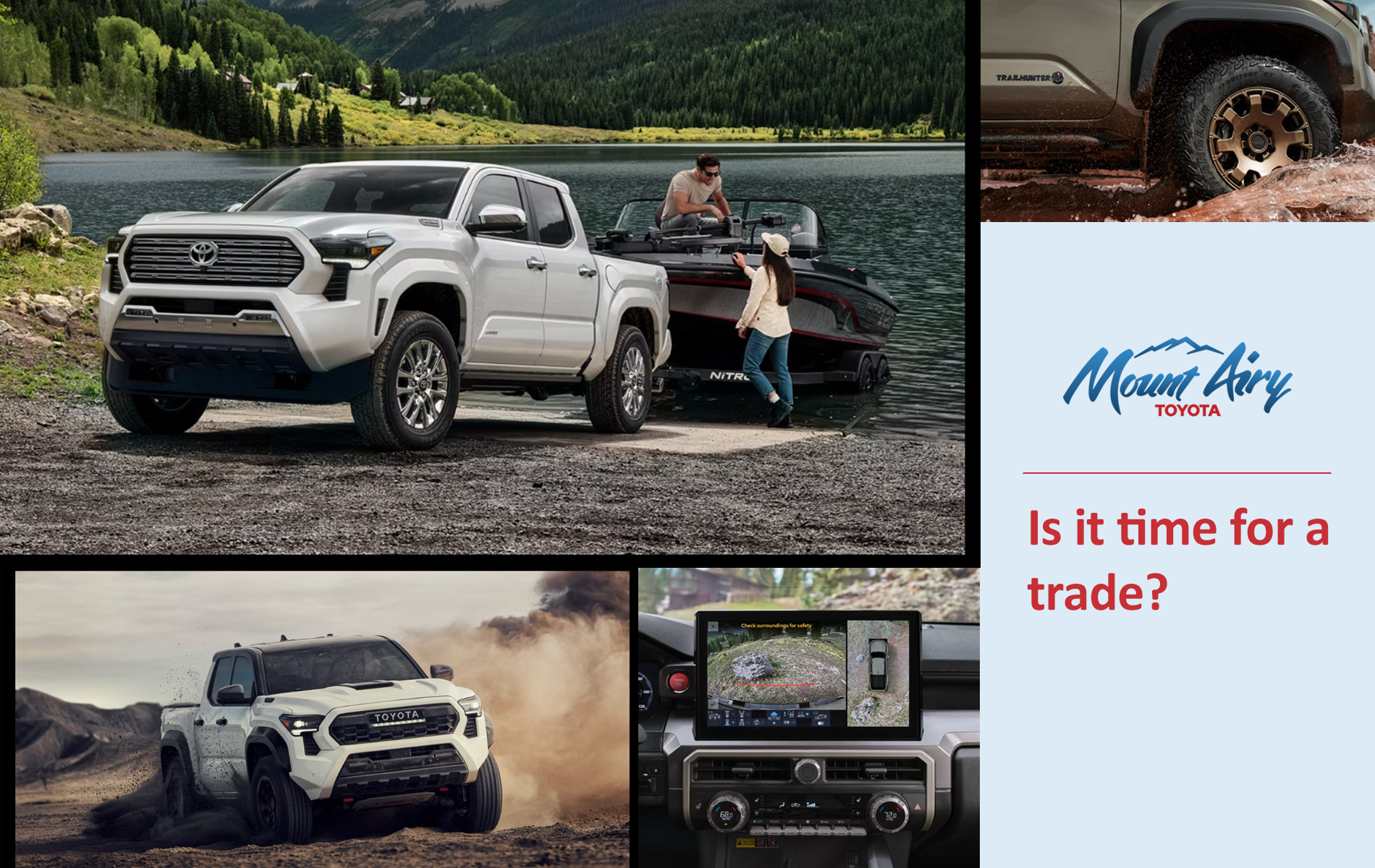
How Long Should You Really Keep a Truck in North Carolina? (And What Most Truck Buyers in Mount Airy Get Wrong)
If you’re driving a truck around Mount Airy, Pilot Mountain, Cana, or anywhere in Surry County, you’ve probably asked yourself: “How long should I actually keep this truck before I trade it in for a new one?”
Most modern trucks, including Toyota Tacoma, Ford Ranger, F-150, or RAM, can be reliable and relatively low cost up to 150,000 to 250,000 miles if properly maintained. So the question isn’t about the truck breaking down. It’s more about finding the smartest financial timeframe to trade. When does it stop making financial and practical sense to keep a truck?
It’s also a very different situation if you are a truck driver versus a car or SUV driver. More is expected out of a truck, and they are more often used for work than for pleasure.
How Long Do Most People Keep Their Trucks?
Let’s start with the facts…
We did a little research and found that across the U.S., the following ownership trends are fairly consistent with truck drivers in Surry County:
- The average vehicle on the road in the U.S. is about 12.5 years old
- Many truck owners keep their vehicles 10 years or longer
- The most common trade cycle is between 5 to 7 years
That 5 to 7 year window is where things get interesting. That is usually the point where:
- Warranty coverage is ending or already gone
- Mileage is starting to climb between 60,000 and 100,000 miles
- Repair costs start creeping in
- Trade-in values are still relatively strong
Why 5 to 7 Years Is the Sweet Spot
Most trucks today come with:
- 3 year or 36,000 mile basic warranty
- 5 year or 60,000 mile powertrain warranty
Once you move past that 5 year mark, you are on your own for most repairs.
Now, that doesn’t mean your truck is about to fall apart. Not even close. But it does mean:
- Brake systems, tires, and suspension components start wearing down
- Electronics and sensors become more expensive to fix
- Maintenance costs become less predictable
At the same time, your truck still holds solid resale value, especially if it has been well maintained. That is why a lot of financially savvy buyers in North Carolina choose to trade somewhere in that 5 to 7 year range.
The idea is that you are not running the truck into the ground, but you are also not taking the biggest depreciation hit.
How Trucks Wear in Surry County
There are some differences between national averages and Surry County truck drivers because pickup trucks and work trucks wear differently in mountain areas.
Not all miles are equal. Driving a truck in Surry County is not the same as driving one in flat city traffic somewhere else. Around Mount Airy and Northwest North Carolina, trucks tend to work harder.
- Hauling tools, materials, and equipment
- Driving up and down mountain roads like NC Highway 103
- Towing trailers
- Stop and go driving combined with elevation changes
All of that adds wear to brakes, suspension, transmission, and tires. So while a truck can last 200,000 miles, how it is used locally matters. Many people work in the trades between Greensboro and up into Galax, Virginia. The long miles combined with the demands of construction work often age a truck faster than a commuter vehicle in a flat urban area. It is similar to trucks from northern states. They tend to age faster because of salt, snow, and severe weather conditions. These are important factors to keep in mind when you are considering the value of your truck.
Why People Trade Trucks Sooner Than Planned
Mileage and wear are the top reasons people trade between 5 and 7 years, but drivers commonly report the following reasons for trading sooner:
- Emotional – They want the enjoyment of driving a newer model.
- Jobs – A career change may require a different type of truck.
- Family – Adding a car seat changes everything.
- Towing Capacity – Some trucks simply handle towing better than others.
- Commuting Distance – Newer trucks often offer better fuel efficiency.
- Technology Improvements – Better sound, navigation, and comfort.
- Reliability Concerns – Avoiding the risk of breakdowns.
In a place like Surry County, your truck is not just transportation. It is part of your daily life. We may be a little biased as truck people, but most would agree it matters in this part of North Carolina.
What Most Truck Buyers Get Wrong
So how can you mess this up? Here is where a lot of buyers get it wrong.
When it is time to buy, many people get caught up comparing numbers:
- Payload capacity
- Horsepower
- Towing ratings
- Price differences
- A few inches of space here or there
On paper, a full size truck like an F-150 can look like the better deal. But here is the problem. Most people do not actually use all those features they spent hours comparing. And those small differences, like a few pounds of payload or a couple inches of bed space, do not matter three months after the purchase.
What Actually Matters After You Buy
Once you have owned the truck for a few months, the numbers fade away. What does not fade is your daily experience.
- Are you comfortable driving to work?
- Are you getting good gas mileage running Highway 52 to Winston-Salem or Greensboro?
- Can you navigate Mount Airy traffic and parking lots easily?
- Is your family comfortable when heading up NC Highway 103 into the mountains?
- When you hit that same speed bump every day, does your truck glide over it or bump along?
People consistently report that comfort, maneuverability, ease of use, climate controls, cup holders, and storage space matter most after a few months of ownership. That is the difference between Best Truck and Best Fit.
Final Thought
Sometimes one truck looks better on paper, especially when you are deciding whether to keep your old one or trade. The numbers might say one thing, but the reality is that you may be happier with a truck that fits your daily life. For many drivers in Mount Airy, Pilot Mountain, and Surry County, a midsize truck like the Toyota Tacoma ends up being the better long term fit. Not because it wins every category, but because it is:
- Easier to live with day to day
- More comfortable on local roads
- Strong in resale value
- Known for long term reliability
When you combine that with smart timing, trading before costs rise and value drops, it becomes a very practical ownership strategy.

Insider Tip
Sometimes the answer to “Should I trade this truck?” comes down to strategy.
Watch this video from Rick Coburn to learn:
- Why Kelley Blue Book may not be your best pricing tool
- How dealers evaluate trade ins
- How to negotiate your trade more effectively
If you are in Mount Airy, Pilot Mountain, Galax, or anywhere in Surry County and want to talk through your options, give us a call at 336-786-2118.
We will help you find a truck that actually fits your life, not just your spreadsheet.
A Local Comparison for Surry County Drivers
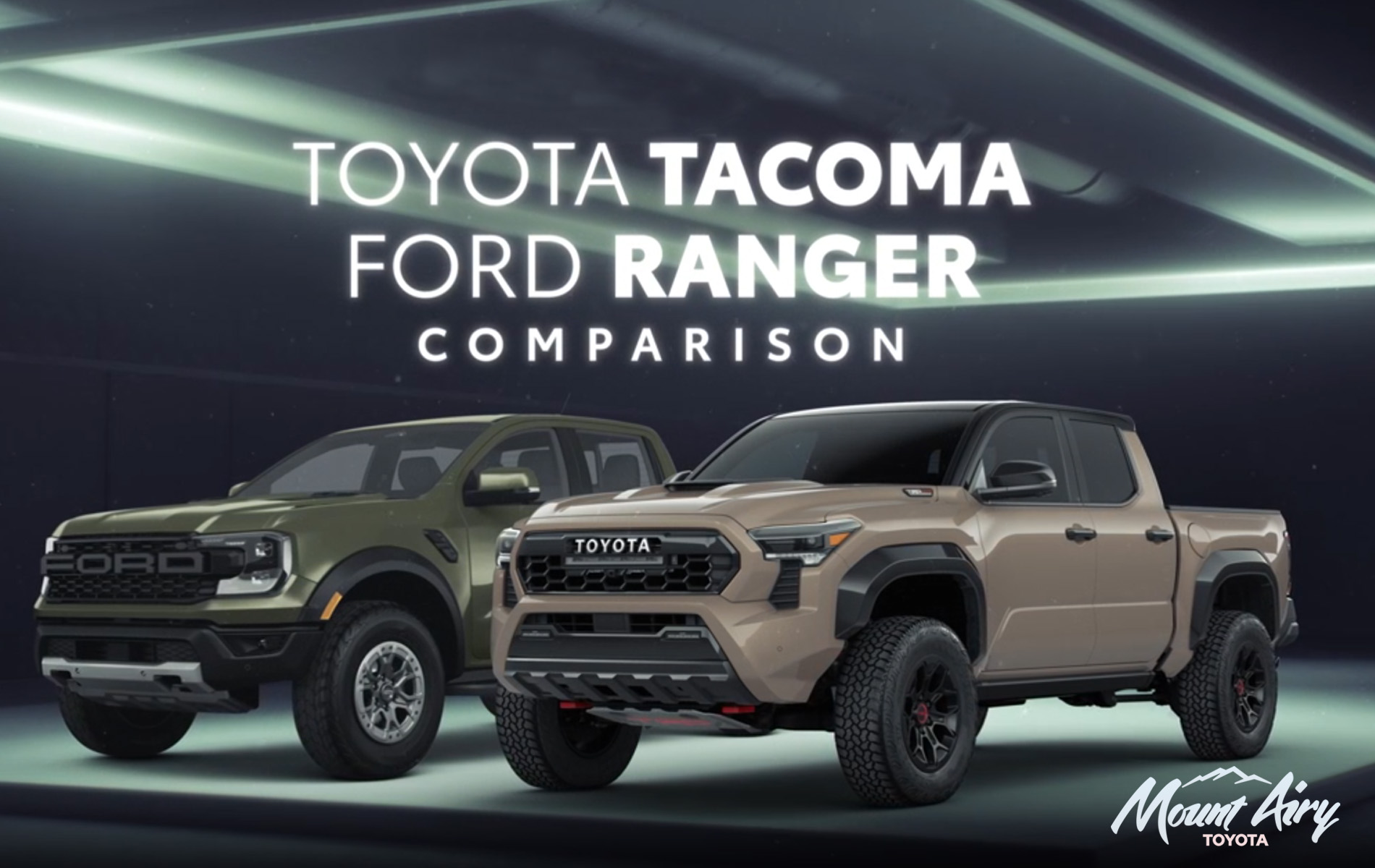
If you’re shopping for a New or Used Toyota Tacoma in Mount Airy, NC or comparing it to a Ford Ranger near Pilot Mountain, Galax, or anywhere in Surry County, you’ve narrowed it down to two very solid midsize trucks.
Bottom line — both are good choices.
The real decision comes down to two simple questions:
One: How will you use your truck around Mount Airy and Northwest North Carolina?
Two: How important is long-term resale value?
How Will This Truck Fit Into Your Daily Life in Surry County?
Don’t just compare numbers — compare lifestyles. After the purchase, payload differences and acceleration times fade away. What remains is how the truck fits your daily routine. Is it comfortable on your commute? Easy to maneuver in town? Simple to operate when you just want the heat on and the cup holder within reach? How does it feel going over the same speed bump you hit every day?
If you regularly haul construction materials across Mount Airy, Cana, or over toward Wilkesboro, the Ford Ranger does offer a slightly higher payload — 1,366 lbs compared to the Toyota Tacoma’s 1,200 lbs.
But let’s put that into perspective.
The difference is only 166 lbs. That’s roughly the weight of one extra adult or a couple of extra bags of concrete. For most drivers in Mount Airy, that difference rarely changes day-to-day life.
Now think about how you actually use your truck.
If you’re commuting from Mount Airy to Winston-Salem or Greensboro on Highway 52…
If you’re driving NC Highway 103 between North Carolina and Virginia…
If you’re running errands in Surry County or heading out for a weekend in the Blue Ridge Mountains…
Comfort starts to matter.
The Toyota Tacoma offers:
- A smoother ride thanks to rear coil springs
- Available heated and cooled seats
- Strong rear-seat storage for tools, gear, or a 12-pack of water
- Hybrid options for better fuel efficiency
On those winding mountain roads around Pilot Mountain, Fancy Gap, and West Jefferson, the Tacoma’s coil spring suspension provides a more compliant, controlled feel compared to the Ranger’s leaf springs. Over time, especially on twisty, uneven pavement, that smoother ride makes a difference.
For daily driving in Mount Airy and across Northwest North Carolina, that comfort adds up.
Simple Controls for Everyday Driving
We hear it all the time from drivers around Surry County — not everyone wants to dig through a touchscreen just to adjust the heat in January.
Toyota kept physical HVAC buttons in the Tacoma. They’re simple. They work. They’re easy to operate on the go.
You still get modern features like push-button start and remote start. But the everyday controls remain practical and user-friendly — something many North Carolina truck buyers appreciate.
How Important Is Long-Term Resale Value in North Carolina?
When shoppers compare the Toyota Tacoma vs. Ford Ranger in North Carolina, resale value often becomes the deciding factor.
Year after year, Toyota trucks hold their value exceptionally well across Mount Airy, Winston-Salem, Greensboro, and throughout the state.
Toyota’s resale strength isn’t accidental. The company has maintained pricing discipline for decades, avoiding heavy discounting just to match short-term local competition. That consistency helps protect long-term value and keeps resale prices strong.
And there’s something else our service team hears often from Tacoma owners in Surry County:
When you walk out to your truck in the morning, you expect it to start — and it does.
Toyota has built a worldwide reputation for reliability, and that matters whether you’re driving around Mount Airy, heading into Virginia, or taking a weekend trip into the mountains.
The Practical Decision
Here’s the straightforward way to think about it:
Do you need the ability to carry one more bag of concrete occasionally?
Or would you rather enjoy a smoother, more comfortable ride every single day?
Most drivers in Mount Airy, Pilot Mountain, Galax, and across Surry County use their truck for commuting, errands, work projects, short vacations, and seasonal fishing trips far more often than they max out payload capacity.
For most North Carolina truck buyers, comfort, reliability, and long-term value win out.
That’s why many local drivers choose the Toyota Tacoma.
If you’re looking for a Toyota Tacoma near Mount Airy, NC, or comparing it to a Ford Ranger in Surry County, we’d be glad to help.
Call us at 336-786-2118 to schedule a test drive. Whether you’re coming from Mount Airy, Pilot Mountain, Galax, Cana, or anywhere nearby, we’ll have your Tacoma ready when you arrive.
2026 Toyota Tacoma vs. 2026 Ford Ranger
Side-by-Side Comparison
Performance & Capability
| Toyota Tacoma | Category | Ford Ranger |
| 2.4L Turbo 4-cylinder / Hybrid available | Base Engine | 2.3L Turbo 4-cylinder (270 hp) |
| ~243–317 lb-ft (varies by trim) | Torque | ~310 lb-ft |
| ~1,200 lbs | Payload | ~1,366 lbs |
| Rear coil springs | Rear Suspension | Rear leaf springs |
| Smoother daily ride | Ride Comfort | Firmer ride unless loaded |
| Rear locking differential | Off-Road | Rear locking differential |
| Crawl Control & terrain modes | Drive Modes | Terrain management modes |
Interior & Comfort
| Toyota Tacoma | Category | Ford Ranger |
| Heated & cooled seats available | Seat Comfort | Heated seats available |
| Power seats available | Power Seats | Power seats available |
| Push-button start | Convenience | Push-button start available |
| More interior storage | Storage | Practical storage layout |
| Rear seats fold down with under-seat storage | Rear Utility | Rear seats fold up |
| Slightly more rear legroom | Rear Legroom | Slightly less rear legroom |
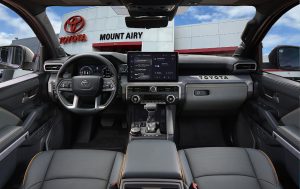
| Physical HVAC buttons | Climate Controls | More screen-based controls |
| Bedliner often standard | Bed Features | Bedliner optional |
| No 360° camera on most trims | 360 Camera | Available 360° camera |
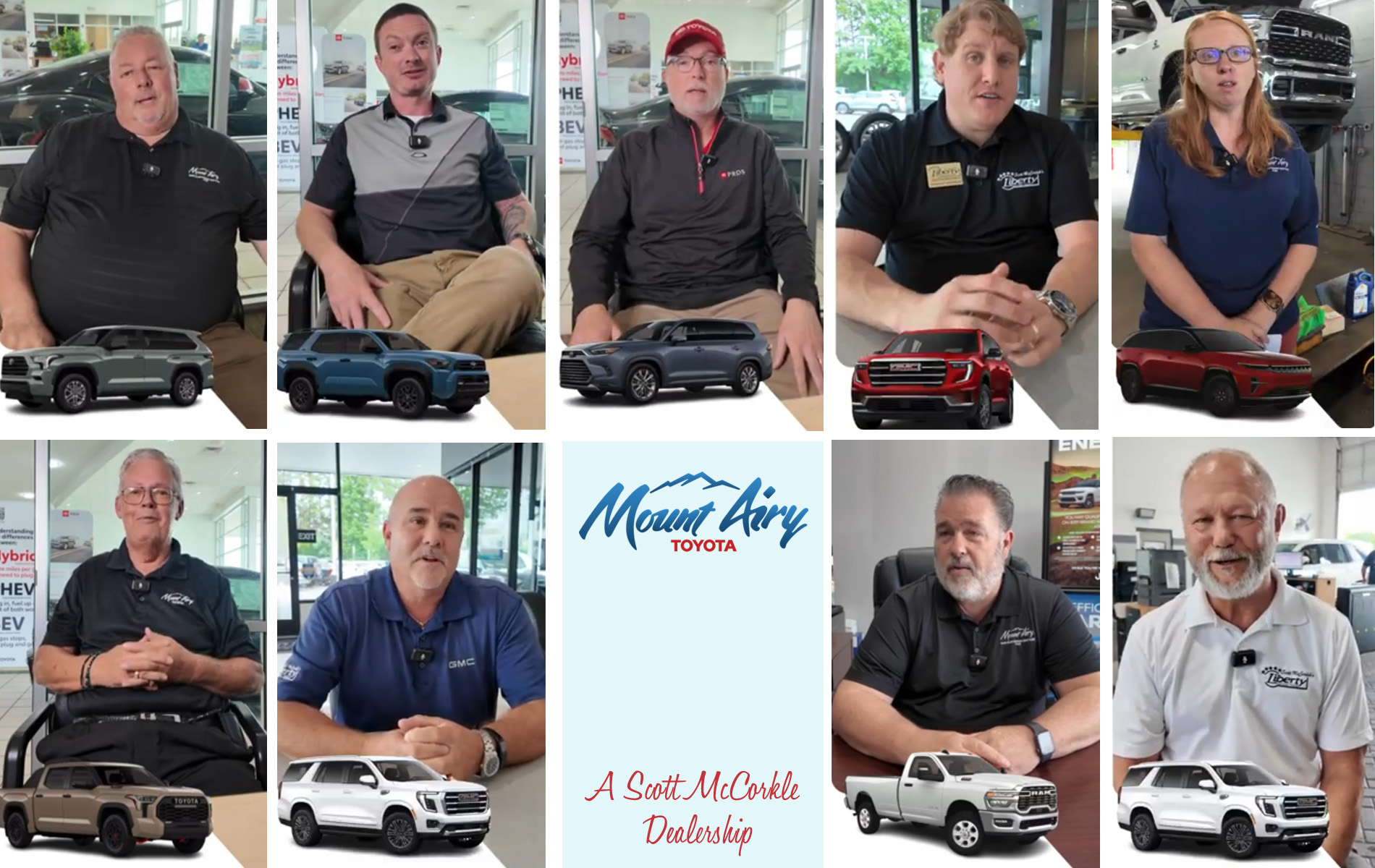
Our team members are excited to share their favorite vehicles for 2026! We recently put together a fun “Favorite Vehicle” composite video featuring many of our employees from the Scott McCorkle family of dealerships. Team members from Mount Airy Toyota, along with colleagues across our organization, weighed in on the vehicles they personally love and trust most.
Because this video represents multiple Scott McCorkle Dealerships, you may hear our team mention Chrysler, Buick, GMC, or Jeep vehicles alongside Toyota favorites. Our Mount Airy Toyota team is very proud to present our favorite Toyota vehicles! They selected vehicles based on reliability, performance, efficiency, and long-term value.
Watch the full “Favorite Vehicle” video on the Mount Airy Toyota YouTube channel, then read on to see why these Toyotas continue to be fan favorites in 2026.
Employee Favorites for 2026:
Toyota 5th-Gen 4Runner (2010–2024) + Details On What’s New for 2026
Recommended by: Chris Pack — Certified Toyota Service Advisor
The Toyota 4Runner has earned a reputation for being tough, dependable, and built to last. Chris recommends the 5th-generation 4Runner because he sees firsthand how well these vehicles hold up over time. They are easy to maintain, capable in all kinds of weather, and just as comfortable for daily driving as they are for weekend trips.
Many 4Runner owners keep their vehicles for years and often well past 200,000 miles, which speaks to Toyota’s build quality.
Why Owners Love the 4Runner
-
Known for long-term reliability
-
Simple, proven design that is easy to service
-
Strong off-road capability without being complicated
What’s Coming with the 2026 4Runner
The redesigned 2026 4Runner keeps what people like and adds modern updates.
-
New turbocharged and available hybrid powertrains
-
Improved fuel efficiency
-
Updated off-road features on select trims
-
A wide range of trims for different driving needs
Top Features Owners Appreciate
-
Body-on-frame durability
-
Confident on-road and off-road performance
-
Available hybrid option
-
A strong reliability record
Toyota TRD Tundra
Recommended by: Rick Coburn — Experienced Sales Professional
Rick’s pick is the Toyota TRD Tundra . It offers the power and capability truck owners want, along with the comfort and technology most drivers expect today. It is enjoyable to drive, capable for tough jobs, and remains one of Toyota’s most popular trucks year after year.
Why the Tundra Stands Out
-
Strong engine options, including a hybrid
-
Comfortable and well-designed interior
-
Solid towing and hauling capability
-
Built for work and everyday driving
2026 TRD Tundra Highlights
-
Multiple cab, bed, and drivetrain choices
-
Gas and hybrid powertrain options
-
Modern technology paired with durability
-
Confident performance for work or recreation
Toyota RAV4 Hybrid
Recommended by: Thomas Williamson — Mount Airy Toyota General Manager
Thomas is a huge fan of the RAV4 Hybrid, especially because of the real-world fuel economy. He regularly sees up to 37.5 miles per gallon on mountain roads, making it a great option for drivers who want to save fuel without giving up space or comfort.
The RAV4 Hybrid is practical, easy to own, and works well for commuting, family life, and road trips.
Why the RAV4 Hybrid Is So Popular
-
Excellent fuel economy
-
Smooth and quiet driving experience
-
Comfortable ride with useful cargo space
-
A strong choice for daily driving
What’s New for the 2026 RAV4 Hybrid
-
Hybrid power is now standard
-
Updated screens and interior technology
-
Standard Toyota Safety Sense
-
Multiple trims to fit different needs
Toyota Grand Highlander Hybrid MAX Platinum
Recommended by: Todd Gentry — Sales Manager
Todd’s favorite is the Toyota Grand Highlander Hybrid MAX Platinum . This three-row SUV offers the space families need with the comfort and features many buyers want. It feels refined, easy to drive, and well suited for longer trips or everyday errands.
Why Customers Like It
-
Seating for up to seven or eight passengers
-
Strong hybrid performance
-
Comfortable and upscale interior
-
Plenty of passenger and cargo room
Standout Features for 2026
-
Hybrid MAX powertrain
-
Toyota Safety Sense 3.0 standard
-
Premium interior materials and technology
-
Smooth and confident ride
Why These Picks Matter
Whether you are looking for off-road capability, fuel efficiency, truck strength, or three-row space, these Toyota vehicles represent what our team believes Toyota does best.
When the people who sell, service, and drive these vehicles every day choose them for themselves, it says a lot.
Visit Mount Airy Toyota today or browse our inventory online to find the Toyota that fits your lifestyle.
The Ultimate End-of-Year Car Buying Guide: How to Get the Best Christmas Deal at Mount Airy Toyota
If you’re thinking about buying a car during the Christmas season or before the end of the year, you’re already on the right track. Year-end is one of the best times to buy—but only if you understand how dealerships actually think, buy, sell, and value vehicles.
To help local buyers make smart, confident decisions, Mount Airy Toyota salesperson Rick Coburn recently shared insider tips straight from the sales floor. His advice cuts through common myths and focuses on what truly gets buyers the best possible deal—both on the vehicle they’re purchasing and the one they’re trading in.
This end-of-year buying guide combines Rick’s insights into one practical roadmap, so you can walk into Mount Airy Toyota prepared, informed, and positioned to win.
Why End-of-Year Is a Smart Time to Buy a Car
December isn’t just about holiday sales—it’s also a critical time for dealerships. Manufacturers have annual sales targets, dealerships are closing out the year, and new inventory is already on the horizon.
That combination creates opportunity—but only for buyers who are serious and ready.
Rick Coburn emphasizes one important truth:
Salespeople are most motivated to give their best deals to buyers who are truly ready and able to purchase.
For more “Insider Tips” Watch Rick’s Video on How To Get Your Best Deal
That means preparation matters just as much as timing.
Step One: Be a “Ready Buyer” Before You Ever Walk In
One of the biggest mistakes buyers make is showing up to a dealership “just to look” during peak buying season. While browsing is fine, the best deals go to customers who come in prepared.
According to Rick, a ready buyer has three things in place:
- Financing or Funding
Whether you’re paying cash, using a credit union, or financing through the dealership, know your numbers ahead of time. Bring documentation or confirmation so there are no delays.
- Insurance Information
Have your insurance agent’s contact info or proof of insurance ready. This keeps the deal moving quickly and shows you’re serious.
- Research Done
Know the model, trim level, and general market value of the vehicle you want. You don’t need to be an expert—but walking in informed builds confidence and credibility.
Why this matters:
Sales professionals prioritize customers who are prepared because those deals are more likely to close smoothly. When a salesperson knows you’re ready, they’re far more motivated to work aggressively on your behalf.
How Dealers Actually Decide Who Gets the Best Deal
Here’s something many buyers don’t realize: dealerships don’t just sell cars—they also manage time, inventory, and risk.
When a salesperson meets a buyer who is organized, decisive, and realistic, that buyer often gets access to better pricing flexibility than someone who is uncertain or unprepared.
At Mount Airy Toyota, Rick explains that readiness signals commitment—and commitment gets rewarded.
Understanding Trade-Ins: What Dealers Really Want
Your trade-in can make or break your overall deal, especially at year-end. Rick Coburn clears up several misconceptions about how dealers value trade-ins.
For more “Insider Tips” Watch Rick’s Video on How To Get The Most Money for Your Trade
Dealers Prefer Local Trade-Ins Over Auctions
This surprises a lot of people, but it’s true:
Dealers would much rather buy cars from their local community than from auction.
Why?
- Local vehicles often have known histories
- They’re easier to inspect accurately
- There’s less transport cost and risk
- Dealers can resell them faster and more confidently
That means if you’re trading in a vehicle locally at Mount Airy Toyota, you already have an advantage.
Prime Condition = Prime Money
Another key takeaway from Rick’s advice is simple but powerful:
If your car is in prime condition, dealers will pay prime money.
Before you trade in your vehicle, take time to:
- Clean it thoroughly (inside and out)
- Address minor cosmetic issues if affordable
- Bring maintenance records if you have them
- Be honest about condition and history
You don’t need perfection—but a well-maintained vehicle shows pride of ownership and reduces uncertainty for the dealership.
Own Your Vehicle? Bring These Documents
If you own your vehicle outright, Rick strongly recommends bringing:
- The vehicle title
- Current registration
Having these documents on hand speeds up the appraisal and buying process dramatically. During busy Christmas and year-end periods, efficiency matters—and smoother transactions often lead to smoother negotiations.
Why Kelly Blue Book Isn’t the Final Word
One of Rick’s most important warnings for buyers is this:
Kelly Blue Book is not an appraisal tool.
While KBB can give a general idea of value, it doesn’t account for:
- Local market demand
- Regional inventory shortages
- Actual dealer reconditioning costs
- What cars are selling for right now
At Mount Airy Toyota, trade values are based on real-world market conditions, not generic national averages. Trusting only an online estimator can lead to unrealistic expectations and missed opportunities.
How to Maximize Your Trade Value at Year-End
To get the best possible trade-in deal during Christmas or year-end sales:
- Trade locally instead of selling privately or relying on auctions
- Present your car in the best condition possible
- Bring title and registration if owned
- Be open to professional appraisal instead of online estimates
- Combine your trade with a ready purchase plan
When these pieces align, dealers are far more willing to be competitive.
Why Mount Airy Toyota Is Different
Mount Airy Toyota isn’t just focused on moving cars—it’s invested in serving the local community. Buying and selling vehicles locally helps strengthen relationships, build trust, and create better long-term outcomes for customers.
Rick Coburn’s advice reflects a dealership culture that values transparency, preparation, and mutual respect.
When buyers understand how the process works, everyone wins.
Christmas & Year-End Buying Checklist
Before visiting Mount Airy Toyota, make sure you have:
- ✔ Financing or payment plan ready
- ✔ Insurance information available
- ✔ Vehicle research completed
- ✔ Trade-in cleaned and prepared
- ✔ Title and registration (if applicable)
- ✔ Realistic expectations based on market conditions
This checklist alone can put you ahead of most buyers walking through the door in December.
Final Thoughts: Preparation Is the Real Secret to a Great Deal
End-of-year car buying isn’t about tricks, pressure, or gimmicks. It’s about preparation, timing, and understanding how dealerships operate.
Rick Coburn’s insider advice makes one thing clear:
The buyers who win are the ones who come in ready.
If you’re shopping for a Christmas gift, planning a year-end purchase, or looking to maximize your trade-in value, Mount Airy Toyota is ready to help—especially when you’re ready too.
For more insider tips, expert guidance, and current inventory, visit https://www.mountairytoyota.com and experience what informed car buying should feel like.
Why Mount Airy Drivers Need to Pay Extra Attention
– Insights from Top Service Manager Chris Pack
Driving in the Blue Ridge Mountains is beautiful—but it’s also harder on your vehicle than most people realize. Our top service manager, Chris Pack, explains in two recent videos that mountain driving and dramatic temperature swings put extra strain on both brakes and tires. Long downhill grades, constant elevation changes, sharp curves, and hot-cold seasonal extremes all speed up wear that would be mild in flatter regions.
His message is simple:
Stay ahead on brake and tire maintenance, and you’ll save money—and stay much safer—than waiting until something goes wrong.
Below is your complete guide to brake and tire care in mountain conditions, including answers to the most-searched questions drivers ask online.
Why Are the Mountains Tough on Brakes?
In the Mount Airy region, the steep, twisty mountain roads mean drivers brake more often and more aggressively than those in flat areas. Add temperature swings—from freezing winter mornings to hot summer afternoons—and brake components expand, contract, and wear out faster.
This combination makes proactive brake maintenance essential, not optional.
Is it safe to drive with bad brakes?
Driving with worn or failing brakes is dangerous anywhere—but especially in the mountains. If you must drive, stopping distance will be much longer, and you’ll need to avoid sudden braking. On steep grades, failing brakes can overheat quickly, leading to brake fade and a loss of stopping power.
Can you replace your own brakes?
Yes, some drivers choose to replace their own brake pads—but only if they truly understand the process. Brake work requires precision and proper safety handling. Front brakes are usually more straightforward, but rear drum brakes or advanced braking systems can be tricky.
If in doubt, it’s safer (and often cheaper long-term) to let a certified Toyota technician handle it.
What are the signs of worn brakes?
Look and listen for:
- Squealing, grinding, or scraping noises
- A soft, spongy, or vibrating brake pedal
- Visible thin brake pads (check through the wheel spokes)
- Dashboard brake warning lights
- Longer distances required to stop your vehicle
If you notice these signs, schedule service right away—mountain braking only accelerates the problem.
Should I replace all four brake pads at once?
Ideally, yes. At the very least, brakes should be replaced in axle pairs (both fronts together or both rears together).
Installing pads unevenly can lead to unbalanced braking, which may cause pulling, extra wear, or unsafe stopping behavior—especially on winding NC mountain roads.
What’s included in a full brake job?
A comprehensive brake service typically includes:
- A complete brake system inspection
- Replacement of worn pads
- Resurfacing or replacement of rotors
- Inspection or servicing of calipers, brake lines, and hydraulic components
- Brake fluid check or replacement
This ensures your entire system—not just one component—is operating safely.
How much do new brakes cost at a typical Toyota dealership?
Pricing varies by model, but generally:
- Brake pad replacement: $150–$300 per axle
- Pads + rotors: $500–$800 for all four wheels
Your exact total depends on the vehicle, parts used, and how much wear has occurred. Mount Airy Toyota always provides upfront pricing so you know exactly what to expect.
How often should car brakes be replaced?
Most vehicles need new brakes somewhere between 25,000 and 65,000 miles.
However, here in the mountains of North Carolina, brakes tend to wear out sooner due to:
- Repeated downhill braking
- Sharp curves requiring frequent speed adjustments
- Frequent temperature swings
For mountain driving, we recommend inspections every 10,000–12,000 miles or at every oil change.
Does the quality of my tires affect my brake life?
Absolutely. High-quality, properly inflated tires help the vehicle grip the road more effectively, reducing the amount of work your brakes must do. Poor-quality or worn tires make your braking system work harder and wear out faster.
Why Mountain Driving Is Tough on Tires
Like brakes, tires suffer more in our region. Curvy, hilly roads, temperature fluctuations, and rougher mountain surfaces all contribute to faster wear. According to Chris Pack, neglecting tires in the mountains can be as dangerous as neglecting your brakes.
Here’s how tires directly impact braking performance:
How Tire Quality Impacts Brake Life
- Better grip = less brake strain
High-quality tires use stronger rubber compounds and smarter tread patterns.
When grip improves, stopping distance gets shorter—and your brakes don’t have to work as hard.
- Improved stopping power and less ABS activation
Good tires maintain traction longer, allowing brakes to apply force without slipping.
This means your ABS doesn’t need to intervene as often, which reduces stress on brake components.
- Worn tires increase brake wear
As tires lose tread, they struggle to grip the pavement—especially on wet or sloped mountain roads.
This causes brakes to work harder and heat up more quickly, accelerating pad and rotor wear.
- Proper tire pressure is critical
Both underinflated and overinflated tires reduce your braking efficiency. Maintaining the recommended tire pressure helps ensure optimal traction, stability, and braking performance.
Final Thoughts from Mount Airy Toyota
Mountain driving demands more from your brakes and tires than typical conditions. That’s why Chris Pack and our entire service team emphasize regular inspections, timely replacement, and investing in quality components.
By keeping up with brake and tire maintenance, you’ll:
✔ Stay safer on the road
✔ Prevent costly repairs
✔ Enjoy smoother, more controlled driving
✔ Extend the life of your vehicle
If you have questions or want a complimentary brake or tire inspection, the Mount Airy Toyota Service Center is here to help.
Chris Pack’s Tire Tips | Mount Airy Toyota Expert Explains Tire Types & Maintenance
Choosing the Right Tires for Your Toyota in Mount Airy, NC
When you live and drive in the foothills and mountains around Mount Airy, NC, your tires aren’t just rubber on the road—they’re your first line of defense against unpredictable mountain weather, icy roads, and rugged terrain. At Mount Airy Toyota, our service team knows that choosing the right tires can make all the difference in safety, performance, and comfort. In our recent YouTube Short, our Service Manager, Chris Pack, walks through how different vehicles, driving styles, and terrain demand different tires. You’ll learn of how tire treads vary and why one size doesn’t fit all. That visual short helps bring this tire education to life. Whether you drive a sedan, SUV, or truck, your tire needs are unique. Add in the challenges of snow, ice, rain, and gravel roads—and it’s easy to see why one-size-fits-all tires simply don’t work. Let’s explore how to choose the perfect tires for your Toyota—and why now is the perfect time to take advantage of Toyota’s Buy 3, Get the 4th for $1 Tire Sale!
Why Tire Choice Matters in the Mountains
Driving in Mount Airy means tackling steep inclines, winding roads, and seasonal snow or ice. Your tires must handle all of it while providing grip, comfort, and fuel efficiency. The right tire for the right vehicle and terrain means safer driving. Elevation changes create more stress on tires, snow and ice require flexibility, rough terrain demands durability, and rain needs special tread channels. The right tires keep you safe and performing year-round.
Types of Tires and Their Best Uses
Different vehicles and driving styles call for different tire types. Here’s a breakdown of the most common categories—some of which you’ll see demonstrated in the video.
| Tire Type | Best For | Ideal Vehicles | Terrain & Conditions | Key Features |
|---|---|---|---|---|
| All-Season Tires | Everyday driving | Sedans (Camry, Corolla), Crossovers (RAV4) | Moderate climates, light snow | Balanced tread for comfort & fuel economy |
| All-Terrain Tires | Mixed on/off-road use | SUVs (Highlander, 4Runner), Trucks (Tacoma, Tundra) | Dirt, gravel, mud, snow | Deep treads & reinforced sidewalls |
| Winter / Snow Tires | Cold and icy conditions | Any vehicle used in winter | Snow, slush, ice | Softer rubber and added siping |
| Performance Tires | Sporty handling | Sport models (GR86, Camry XSE) | Dry roads, high speeds | Low tread depth for cornering & braking |
| Mud-Terrain Tires | Off-road adventure | 4×4s and lifted trucks | Mud, rocks, deep ruts | Aggressive tread & self-cleaning |
| Touring Tires | Long-distance comfort | Sedans, hybrids | Highways & paved roads | Quiet ride and even wear |
Tires for Sedans
Toyota sedans like the Camry, Corolla, and Avalon need tires that balance comfort, fuel efficiency, and traction for changing weather. Recommended: All-Season or Touring tires. They offer a quiet ride and handle light snow well. If you compare all-season tire against a winter-rated tire on a frozen surface you will see that traction differences can be dramatic. For sportier handling, performance tires are great, but they’re not ideal for snow.
Tires for SUVs
SUVs like the RAV4, Highlander, and 4Runner face mixed terrain—from city pavement to gravel backroads and snow. Recommended: All-Terrain or All-Season tires. They provide traction on mountains while staying smooth on highways. Swap to winter tires if you drive in higher elevations. The difference between an SUV highway tire and a mixed-terrain tire is in the stiffer sidewalls and deeper grooves that improve control in the mountains.
Tires for Trucks
For trucks like the Tacoma and Tundra, tire choice depends on use. Daily drivers benefit from All-Season or Touring tires for comfort and fuel economy. Work and towing trucks do better with All-Terrain tires for durability. Off-roaders will want Mud-Terrain tires for maximum traction. Heavy-duty tires differ in construction. Those load ratings matter for mountain towing. Truck tires also feature reinforced sidewalls for steep, heavy hauls.
Tires for Different Terrains
Mount Airy roads can mean pavement one day and ice the next. Here’s how tread patterns perform across different conditions:
-
Paved Roads: Smooth tread reduces road noise and improves efficiency.
-
Snow & Ice: Winter tires stay flexible and grip cold surfaces. Look for the snowflake symbol.
-
Gravel & Dirt: All-terrain tires have wider grooves that grip loose surfaces.
-
Mud & Trails: Mud-terrain tires clean themselves to maintain traction.
-
Rain: Deep circumferential grooves prevent hydroplaning by channeling water out from under the tire.
How to Check Your Tires for Wear and Tear
Keep your tires in top shape with these checks:
-
Tread Depth: Use a penny—if you see all of Lincoln’s head, replace the tire. In the video, the manager uses a tread gauge to show this difference.
-
Uneven Wear: Can signal alignment issues. The video shows how edge wear looks on a misaligned tire.
-
Cracks or Bulges: These are signs of damage and need immediate replacement.
-
Pressure: Cold weather and altitude changes can lower pressure quickly—check monthly.
When to Replace or Rotate Tires
Replace tires every 5–6 years or 40k–60k miles, depending on use. Rotate every 5k–7.5k miles to ensure even wear. Alignment should be checked yearly or if your car pulls to one side. Rotation may not be optional for mountain drivers because curves and elevation make uneven wear happen faster.
How Long Tires Last in the Mountains of NC
Mountain driving wears tires faster. Expect:
-
All-Season: 45k–60k miles
-
All-Terrain: 40k–50k miles
-
Winter: 3–4 winter seasons
Keep them inflated, balanced, and rotated for maximum life.
Take Advantage of Toyota’s Tire Sale
Now’s the perfect time to get new tires for your Toyota! Mount Airy Toyota is proud to offer Toyota’s Buy 3, Get the 4th for $1 Sale, available for a limited time. Waiting to replace worn tires means risking your safety—so take advantage of this deal before the first snow hits. Our certified team will match the best tires to your Toyota, terrain, and driving style.
Schedule Your Tire Service Today
Don’t wait for the ice to find out your tires aren’t ready. Visit MountAiryToyota.com or call our Service Center to schedule your tire inspection or replacement today. Drive safer, smoother, and smarter—with the right tires for your Toyota and your mountain lifestyle.
Rodents and Brakes Are Squeaking in Your Car! How to Catch Damage Before It Costs You Big

The Problem of Waiting Too Long
Tech Tips from Chris Pack at Mount Airy Toyota

Many drivers treat auto inspections like an afterthought — “I’ll schedule it when something breaks.” But the reality is, by the time symptoms are obvious (squealing brakes, pulling, fluid leaks), damage is often deep enough to require expensive repair or replacement. A multi-point inspection catches small issues—worn pads, fluid level drops, loose components—before they evolve into bigger problems. The cost of treating early warning signs is negligible compared to full part replacement or safety failures. Set your service appointment today!
RATS! RATS! RATS!
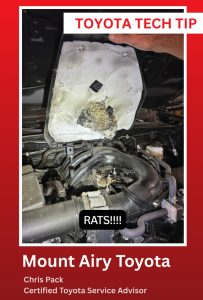
Rodents are small, but the damage they leave behind inside a car engine can be surprisingly big. Warm engine bays attract rats and mice looking for shelter, and once they settle in, chewing becomes inevitable. Wiring harnesses, hoses, and insulation are prime targets because rodents use them to sharpen their teeth. What may look like a minor bite mark can quickly escalate into warning lights, electrical issues, or even a car that won’t start. The cost of replacing chewed wiring harnesses often shocks vehicle owners, since what seems like a small problem usually requires major repairs.
Why the Air Filter Area Matters Most
One of the first places rodents tend to show up is in the air filter box. It’s an easy entry point, and the filter material makes convenient nesting material. The bigger danger, however, comes from rodent droppings. Rat feces inside or around your air filter can contaminate the air moving into your cabin and circulate harmful bacteria and allergens into the vehicle. Beyond the health risk, droppings and debris can clog the filter, reducing airflow and hurting engine performance. This is why routine checks of the air filter are so important—they’re often the first line of defense against a bigger infestation.
Catching the Problem Early
The best way to avoid expensive repairs and potential health hazards is through regular vehicle service. Trained technicians know where to look for early signs of rodent activity, from chewed wiring to nests near the intake. If caught early, rodents can be deterred before they make it past the air filter and into critical components. Waiting too long can turn what could have been a simple cleaning into a costly replacement job. By keeping up with inspections, you not only protect your engine but also ensure the air you breathe inside your car stays safe and clean.
Why Brakes & Pads Deserve Extra Attention
Brakes and pads are among the most critical components for safe driving — and also among the ones that deteriorate gradually. Wear can be uneven, pads may degrade without you hearing or feeling it right away, and brake fluid leaks can sneak up. During a multi-point inspection, technicians closely examine rotor thickness, pad depth, fluid levels, and hardware integrity. They can spot unusual wear patterns, impending failures, and other red flags well before you ever need to hit the brakes hard in an emergency.
The Hidden Benefits That Go Beyond Safety
Of course, safety is paramount — but early detection brings a cascade of benefits. You’ll enjoy lower repair costs, improved fuel efficiency (no dragging or misaligned parts), and enhanced vehicle longevity. Regular inspections also build trust between you and your auto shop; you’re not paying for “surprises,” you’re paying for maintenance. In the long run, a proactive maintenance mindset means fewer breakdowns, fewer roadside emergencies, and more confidence behind the wheel.
Mount Airy Toyota Insider Tips: Straightforward Advice on Car Maintenance, and Hidden Features
At Mount Airy Toyota, we believe car ownership should be empowering—not confusing. That’s why we created the Insider Tips Series, a collection of straightforward tutorials and proven advice on everything from car buying to maintenance, ownership, and service. Each episode takes a practical look at real-world driving challenges and offers expert guidance that helps you save money, avoid costly mistakes, and get more out of your Toyota.
To kick off the series, we’re highlighting two important topics: how mountain driving affects your car and the hidden features built into Toyotas that many drivers never use.
Mountain Driving: What Wears Out First
Driving in the North Carolina mountains is a unique experience. The steep climbs, sharp descents, and winding roads don’t just challenge drivers—they also put extra stress on vehicles. In one of our first videos, Mount Airy Toyota Certified Technician Chris Pack explains that tires, brakes, and fuel consumption take the biggest hit when you drive in the mountains.
Tires
The constant uphill climbs and downhill braking cause tires to wear out faster than on flat terrain. Mountain drivers often find themselves replacing tires sooner than expected, making regular inspections essential. Keeping an eye on tire tread and alignment can prevent uneven wear and extend the life of your tires.
$$$ SAVINGS TIP – Keep your Toyota driving safely with a fresh set of tires—and save big while you do it! Watch our website and social media for the Mount Airy Toyota Tire Sales. We often advertise buy three tires and get the fourth tire FREE.
- Expert Toyota Certified installation
- Tires matched for your model and driving needs
- Boost safety, performance, and fuel efficiency
Brakes
Brakes are one of the most important—and most overlooked—parts of mountain driving. Frequent downhill braking generates more heat and friction, which can wear out pads and rotors at a much faster rate. Getting your brakes serviced on time doesn’t just improve safety; it also saves money. When brake pads are replaced before they wear down completely, you avoid damaging rotors and calipers, which can lead to costly repairs. In other words, preventative service now means avoiding major expenses later.
Fuel Efficiency
Steeper terrain requires more power, which means more fuel. While there’s no way around the physics of climbing mountains, keeping your tires properly inflated, maintaining a clean air filter, and following regular service intervals can help maximize your fuel economy.
The takeaway is simple: regular maintenance is not optional—it’s essential. Staying ahead of tire and brake service not only keeps you safe on mountain roads but also protects your wallet from unexpected repair bills.
Hidden Features: Getting the Most From Your Toyota
Our second video in the series dives into something many drivers overlook: the hidden features built into their Toyotas. These features are designed to make daily driving easier and more convenient, but too often, owners never use them.
Key Fob Technology
Your Toyota key fob is more than just a way to lock and unlock your car. Depending on your model, it can roll down your windows, open the trunk remotely, and even activate a panic alarm with specific button combinations. These functions can save time, add convenience, and improve safety, yet many Toyota owners never take advantage of them.
Watch this video by Mount Airy Toyota Certified Tech, Chris Pack to learn about your Key Fob.
Additional Features Drivers Forget
- Automatic High Beams – Many Toyota models include this feature, which automatically switches between high and low beams to improve nighttime driving safety.
- Eco and Sport Driving Modes – These selectable modes adjust throttle response and fuel efficiency. Eco mode helps save gas, while Sport mode sharpens performance for a more responsive drive.
- Rear Seat Reminder – Designed to alert you to check the back seat before leaving the vehicle, this safety feature helps prevent accidents and forgotten belongings.
- Toyota Safety Sense Alerts – From lane departure warnings to adaptive cruise control, Toyota’s safety systems have customizable settings that many owners never personalize. Taking the time to adjust them can improve your driving comfort and confidence.
By exploring these hidden features, our goal is to help you get the most out of your vehicle. After all, you invested in Toyota quality—you deserve to enjoy every feature it offers.
Why This Series Matters
Between car buying myths, confusing service schedules, and overlooked technology, drivers face a lot of uncertainty. Our Insider Tips Series was created to clear up that confusion. We want to provide:
- Clarity – Cutting through myths with honest, straightforward answers.
- Confidence – Helping you understand your vehicle so you can make informed decisions.
- Cost Savings – Showing you how preventative maintenance and smart ownership habits save money over time.
Each video features our certified technicians and experienced team members, giving you access to insider knowledge without the jargon. Whether it’s understanding how mountain driving affects your brakes or learning a hidden feature on your key fob, the series is designed to make car ownership easier and more enjoyable.
Who Should Watch
This series is for everyone who owns—or is thinking about owning—a Toyota:
- New drivers will gain practical tips without feeling overwhelmed.
- Long-time owners will discover features they might not know about and learn ways to extend their vehicle’s life.
- Families on a budget will find strategies for saving money without compromising safety.
In short, the Insider Tips Series is for anyone who values transparency, expertise, and peace of mind when it comes to their car.
Join the Conversation
The Mount Airy Toyota Insider Tips Series is more than just videos—it’s a resource for our community. We’re here to answer questions, share knowledge, and help you make the most of your Toyota ownership experience.
👉 Subscribe to our channel and follow along as we roll out new episodes. With each one, you’ll gain insights that make driving safer, smarter, and more affordable.
At Mount Airy Toyota, we’re not just here to sell cars—we’re here to help you enjoy every mile.
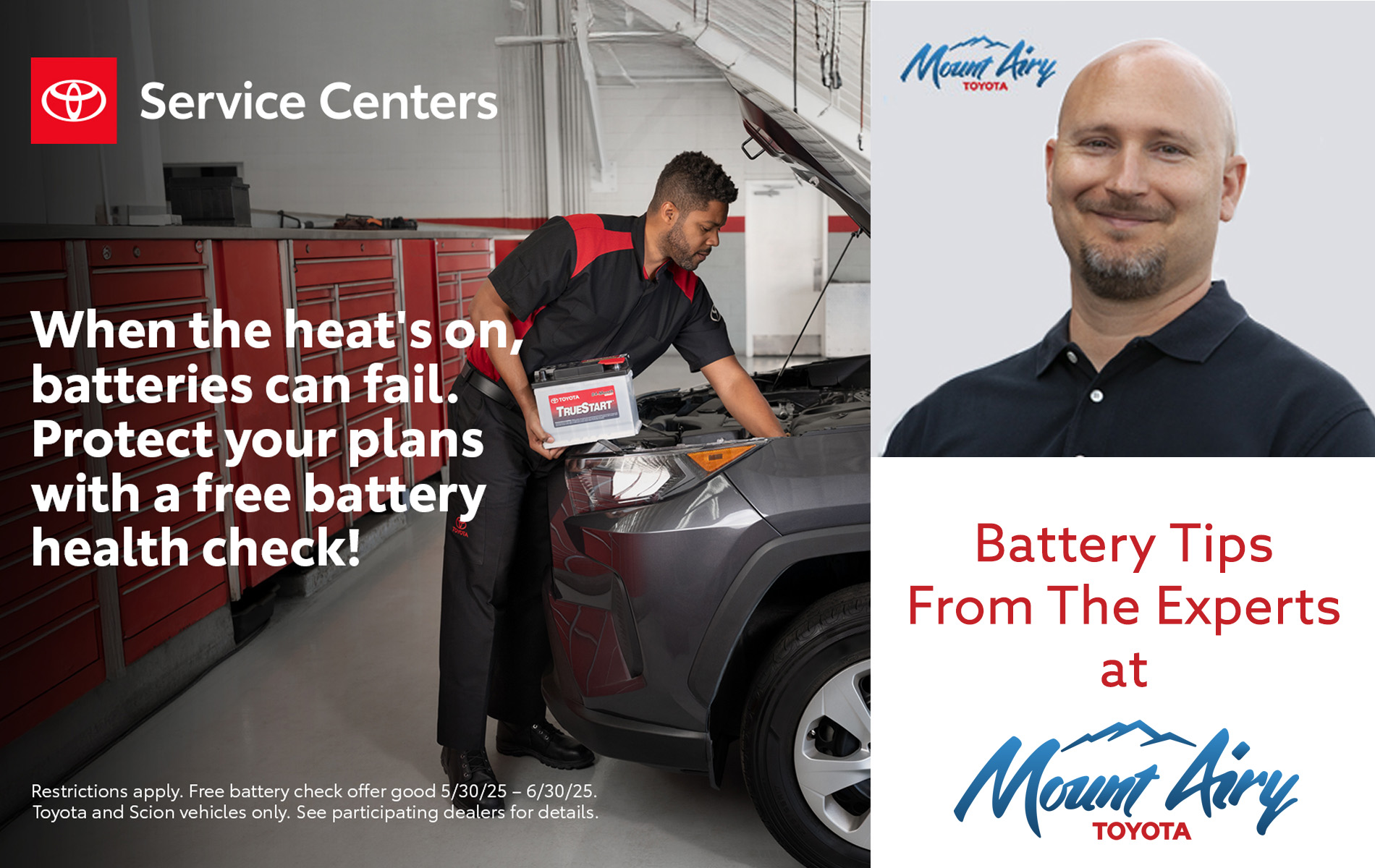
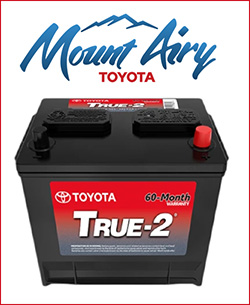
It happens every year about this time. We get a rush of customers with battery issues because of the rapid rise in temperature. It catches people off guard in Mount Airy because we’re used to the extreme cold weather, but never quite as prepared for the heat of summer. To help our customers be more prepared we’ve provided information, special cost savings on batter installation, and tips from our expert mechanics.
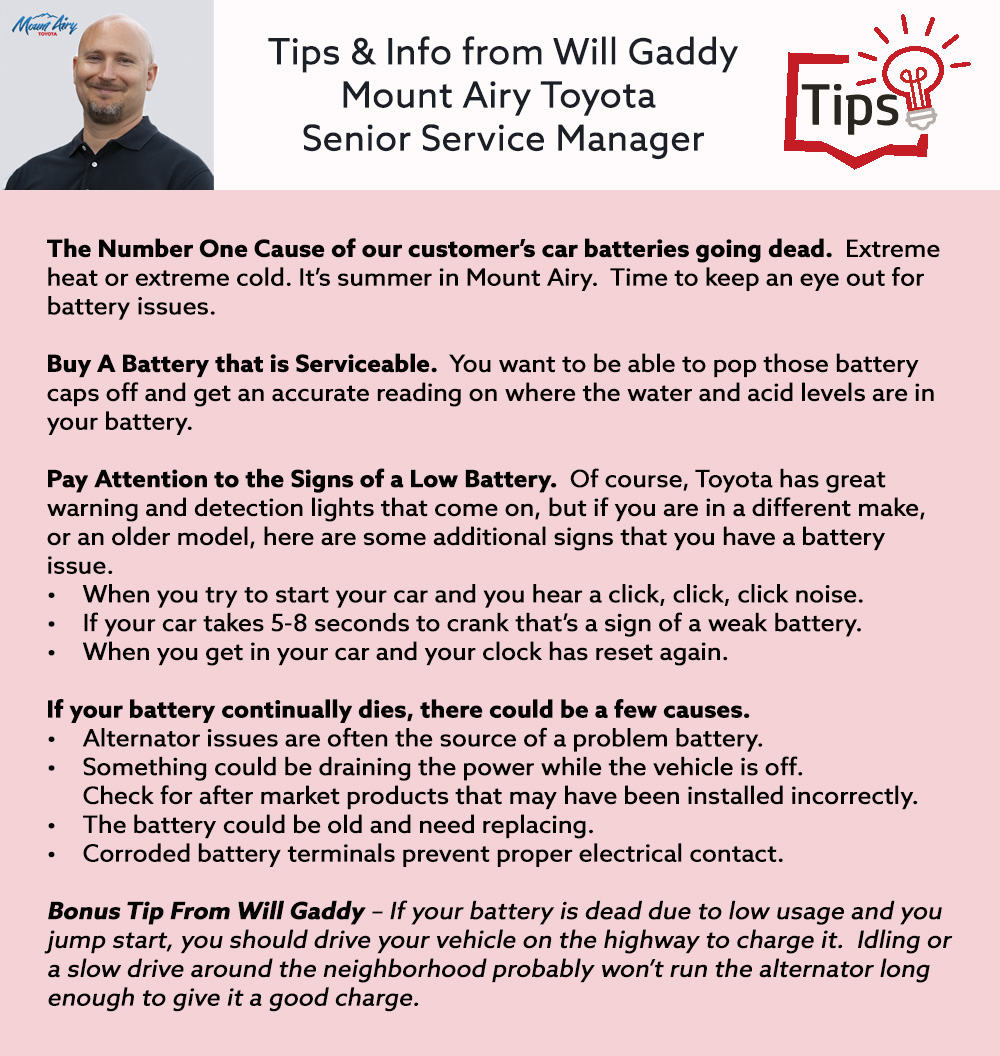
Dead Battery? Here’s What You Need to Know (Before It Happens to You)
We’ve all experienced that sinking feeling when you hop in your car, press the start button or turn the key, and nothing happens. No engine noise, no dashboard lights, no response at all. A dead battery can leave you stranded at the worst possible moment, whether you’re heading to work, picking up the kids, or preparing for a road trip.
Fortunately, a little knowledge goes a long way. Understanding how your car battery works, recognizing the warning signs, and knowing what to do in an emergency can help you avoid unnecessary stress. In this guide, we’ll break down everything you need to know about your vehicle’s battery so you can stay powered up and prepared for the road ahead.
What Exactly Does Your Car Battery Do?
Your car’s battery is much more than a simple power source. It plays a vital role in the operation of your vehicle from the moment you turn it on.
At its core, the battery provides the jolt of electricity needed to start your engine. Without it, your car simply won’t run. Once the engine is started, the alternator takes over to generate electricity and recharge the battery—but that initial burst is critical.
In addition to helping your vehicle start, the battery powers all of your electronic components when the engine is off. These components include:
- Interior and exterior lights
- Power windows and locks
- Infotainment systems and radios
- Climate control systems
- USB chargers and other accessories
If your battery is weak or dying, any of these systems may become sluggish, glitchy, or stop working altogether.
What To Do If Your Battery Dies
If you find yourself with a car that won’t start, there’s a good chance your battery is to blame. But don’t panic, there are a couple of reliable methods to get back on the road. If you’re near Mount Airy Toyota, give us a call or schedule service. We’re ready to help!
1. Try a Jump Start
Jump-starting is one of the most common and immediate solutions when dealing with a dead battery. You’ll need a pair of jumper cables and another vehicle with a fully charged battery.
Step-by-Step Instructions:
- Position the vehicles: Park the working car close enough to the dead car so the cables can reach, but make sure the vehicles are not touching.
- Turn off both engines and remove the keys.
- Connect the cables in the following order:
- Red clamp to the positive terminal (+) on the dead battery.
- Red clamp to the positive terminal (+) on the working battery.
- Black clamp to the negative terminal (–) on the working battery.
- Black clamp to an unpainted metal surface on the engine block or chassis of the dead car (not the battery).
- Start the working car and let it run for a few minutes.
- Try starting the dead vehicle.
Safety Tip: If you’re unsure of where the battery terminals are or how to properly connect the cables, consult your owner’s manual or call a professional. Incorrect connections can cause sparks, damage to the battery, or even injury.
2. Use a Portable Battery Jump Starter
A more modern solution is the portable battery jump starter, often called a “jump box.” These compact, rechargeable devices are a must-have for emergency preparedness.
Unlike jumper cables, a jump starter doesn’t require a second vehicle. Simply connect the clamps to your battery, turn it on, and start your car. Many models feature automatic polarity detection, spark-proof technology, and built-in safety alarms, making them very user-friendly.
Some jump starters also double as:
- USB phone chargers
- Flashlights
- Tire inflators or air compressors
If you travel frequently, live in a remote area, or simply want peace of mind, a jump starter is a smart investment.
Why You Should Check Your Battery Regularly
Like any other part of your vehicle, car batteries don’t last forever. On average, a battery will last between 3 to 5 years, depending on usage, weather conditions, and maintenance habits.
Extreme heat and cold are especially hard on batteries. In hot weather, internal fluids evaporate faster, leading to corrosion and reduced performance. In freezing temperatures, a battery’s ability to hold a charge can drop significantly.
That’s why routine battery checks should be part of your regular vehicle maintenance plan. At Mount Airy Toyota, our technicians can test your battery in just a few minutes during any scheduled service and, if the battery needs replacing, we can have it done in around 15-20 minutes.
We check:
- Voltage – Is your battery fully charged?
- Cold Cranking Amps (CCA) – Can it deliver the power needed to start the car in cold conditions?
- Overall health – Is your battery near the end of its useful life?
Pro Tip: Identifying a weak battery before it fails can save you the cost and inconvenience of a tow truck or emergency repair.
What Happens If You Don’t Replace a Weak Battery?
Ignoring the warning signs of a failing battery might seem harmless at first, until your car refuses to start when you need it most. A dying battery can cause a variety of problems beyond just an inconvenient breakdown.
Here’s what you risk by waiting too long:
- Car won’t start – Often at the worst possible moment (late at night, in bad weather, far from home).
- Strain on the alternator – The alternator may work overtime to compensate, potentially shortening its lifespan.
- Malfunctioning electronics – Lights, radios, navigation systems, and other electronics may start acting erratically.
- Roadside assistance costs – Towing, jump-starts, or emergency service calls can get expensive fast.
Prevention is always cheaper and easier than an emergency.
Signs Your Battery Might Be Failing
Car batteries usually don’t die suddenly. In most cases, they provide warning signs days or even weeks in advance. Recognizing these early symptoms can help you take action before you get stranded.
Common Signs of Battery Trouble:
- Slow engine crank – The engine takes longer than usual to turn over.
- Dim headlights – Especially noticeable when idling or using multiple electronics.
- Clicking noise – A rapid clicking sound when you turn the key or press the start button.
- Dashboard warning lights – Battery or check engine lights may flash intermittently.
- Electrical issues – Infotainment system resets, malfunctioning power windows or locks.
- Corrosion – White or blue powder around the battery terminals is a sign of acid leakage.
- Swollen battery case – This can be caused by overcharging or extreme temperatures.
If you notice any of these, it’s time to have your battery inspected by a professional.
Pro Tips to Make Your Battery Last Longer
While you can’t control everything, good maintenance habits can significantly extend your battery’s lifespan.
Here are some tips to help you get the most out of your car battery:
- Drive regularly: Short trips or long periods of inactivity can drain your battery. Try to drive your car at least once a week.
- Turn off electronics: Before shutting off the engine, turn off lights, radio, and climate control to reduce drain.
- Clean battery terminals: Dirt and corrosion can prevent proper current flow. Use a wire brush and baking soda solution for cleaning.
- Tighten loose connections: Make sure the cables and terminals are snug and secure.
- Avoid extreme temperatures: Park in a garage or shaded area when possible. Extreme heat and cold are tough on battery cells.
- Disconnect when storing: If you’re storing your vehicle for a long time, consider disconnecting the battery or using a trickle charger.
Final Thoughts: Stay Charged, Stay Confident
Your car’s battery might not be something you think about often—but when it fails, you’ll notice immediately. That’s why staying proactive is so important. A simple battery check today could prevent a major inconvenience tomorrow.
Whether you’re gearing up for a summer road trip or just commuting to work, take a few minutes to ensure your vehicle is ready to roll. Don’t wait for warning signs or bad weather to catch you off guard.
Need your battery checked or replaced? Come visit Mount Airy Toyota! Our expert technicians are here to help with quick, reliable battery inspections and replacements. We’ll make sure your Toyota stays powered up, safe, and ready for every mile ahead.

At Mount Airy Toyota, we’re proud to say we have some of the best trade and finance managers in the business. Our team of auto buyers is honest, experienced, and incredibly sharp — and they do their best to give every customer a fair and accurate trade-in value. But let’s be honest: it’s a tough job.
Most of the time, they’re working with just a few quick forms and maybe a photo or two of your vehicle. That’s not a lot to go on! So, what if you could help them — and help yourself — by walking in with a clearer idea of what your vehicle might actually be worth?
That’s where ChatGPT can come in handy.
Using AI to Prep for Your Trade-In
ChatGPT is an Artificial Intelligence Tool that can help you gather all the right information that goes into calculating your car’s trade-in value. The more context you give it, the better it can guide you toward a realistic number — even before you set foot in the dealership.
Here are some helpful questions and factors you can plug into ChatGPT to get a smarter, more customized idea of your car’s value:
Vehicle Condition & History
- What’s the exact year, make, model, and trim?
Trim levels matter — an LE and a Limited can have very different values. - How many miles are on it?
Mileage is one of the biggest value factors. Even “low miles” means different things depending on age. - Have there been any accidents?
Yep, even minor dings count. Transparency helps get a fair trade-in estimate. - Any dents or scratches?
Be honest — normal wear is expected, but big scratches or panel damage should be mentioned. - How’s the paint looking?
Fading, oxidation, or peeling? Or is it still shiny and showroom-fresh? - Are there any warning lights on?
That orange triangle or red exclamation point is something you don’t want to ignore. - Is the check engine light on?
It might be nothing — or something — but definitely worth disclosing. - Are all systems working?
We’re talking about the AC, power windows, radio, heated seats, cruise control, and beyond. - Any leaks under the car?
Oil, coolant, or anything else dripping? That could impact value or you may need to top it off before you visit the dealership. - How are the brakes and suspension?
Smooth stopping and a comfy ride are good signs. Squeaks or rattles? Not so much. - Any weird noises when you drive?
Squealing, grinding, knocking — anything strange should be shared upfront. - Any active recalls?
If there are outstanding recalls, they can affect the resale offer — and safety, too. - Any history of flooding or water damage?
Flood-damaged cars lose a lot of value — and it’s something dealers check for.
Interior Condition
- How do the seats and upholstery look?
Are they spotless or stained, torn, or sun-faded? - Does it have any lingering smells?
Smoke, mildew, food, pets — odors can seriously impact value. - Has anyone smoked in it?
Smoke is tough to get out and worth mentioning. - Got kids?
We love ‘em, but they’re tough on cars. Sticky fingers, melted crayons, ketchup stains and snack crumbs leave their mark. - Any pets ride along?
Hair, scratches, or that unmistakable “dog car” smell — be honest! - Do the seatbelts and airbags work?
Safety equipment needs to be in good shape to pass inspection. - How’s the infotainment system?
Touchscreens, speakers, navigation, or scratches on the screens — any issues there? - Has the interior been cleaned or detailed regularly?
Clean interiors say “well cared for” — and that helps.
Usage & Ownership
- How many owners has it had?
One-owner cars often mean better documentation and history. - Has the title ever been branded?
Salvage, rebuilt, flood, or lemon law branding will definitely affect value. - How did you use the car?
Was it a weekend cruiser, a daily commuter, or a worksite warrior? - Was the vehicle used for Uber, Lyft, or delivery services?
High daily mileage and heavy usage tell a different story than casual use. - What kind of driving did it mostly do?
Highway miles are easier on a car than city driving or off-road use. - Was it used to tow?
If you hauled trailers, boats, or campers, that’s something to note. - Where do you live?
Region affects value. A 4WD SUV in Colorado might be worth more than the same one in Miami. - What’s the weather like there?
Snow, salt, heat, and humidity all age a car in different ways. - Where do you park your car?
Home Garage, Public Garage, Driveway or Street parked? A garage adds a layer of protection and value.
Maintenance & Care
- Do you have maintenance records?
Receipts and service logs, especially from an authorized dealer, help you prove the car’s been cared for. - Did you stay on top of routine service?
Oil changes, filter swaps, tire rotations — consistency builds confidence. - Was service done at a dealership or local shop?
Both are fine, but brand dealerships tend to be yield more comprehensive service results over time. - Have major parts been replaced?
Think spark plugs, timing belt, or transmission fluid — the big-ticket stuff. - How are the tires?
Lots of tread or nearly bald? That affects road safety and trade-in value. - Are they all-season, winter, or summer tires?
The type tells a story about use and prep. - Are the tires all the same brand and age?
Mismatched tires may raise red flags. Matching sets look more cared-for. - Any parts recently replaced?
Battery, brakes, alternator — fresh parts are a bonus. - Was it recently inspected or certified?
A clean bill of health from an inspection or certified program can increase your offer.
Modifications & Add-Ons
- Have you added any aftermarket parts?
Upgraded wheels, lights, grills — let us know what’s custom. - Were those installed professionally?
Pro installs usually increase value (and reduce liability concerns). - Any performance mods?
Suspension kits, exhaust systems, or engine tuning definitely matter. - Does it have a remote starter or roof rack?
Those extras might be worth more than you think! - Any tech upgrades?
Dash cams, parking sensors, rearview cameras — small gadgets add convenience and appeal. - Are the windows tinted?
And was it done at a shop or DIY? That matters for legality and longevity. - Added any upgrades or accessories?
Running boards, cargo organizers, premium floor mats — even small things can add value.
Most importantly, share your vehicle photos with ChatGPT. Here’s how:
How to Share Photos with ChatGPT for Trade-In Evaluation
To help ChatGPT give a more complete evaluation of your vehicle, consider uploading clear, high-quality photos. Be sure to include:
- Exterior shots from multiple angles (front, back, sides, and diagonal views)
- Close-ups of any damage, scratches, or dings
- Interior shots showing seats, dashboard, infotainment, and any signs of wear
- Tire photos showing tread depth (hold a penny or tread gauge up close for scale)
- Photos of the odometer, VIN, and service stickers (if available)
Once you upload these, ChatGPT can give you more insight into how your car’s condition may affect trade-in value. Keep in mind that while AI can’t replace an in-person appraisal, it can help you be better informed — and that means a stronger negotiating position when you’re ready to trade.
Think Ahead: What’s Your Next Toyota?
Once you’ve used ChatGPT to get a ballpark trade-in value, you can also start dreaming about your next Toyota. Let ChatGPT help you crunch the numbers and figure out what fits your budget.
Just add some of your financial details, like:
- How much you owe (if anything) on your current vehicle
- How much you’ve saved for a down payment
- Your estimated monthly budget for a car payment
- Whether you’re planning to finance or lease
ChatGPT can then walk you through payment estimates, potential financing options, and what models might be a good fit based on your lifestyle, estimated trade-in, and budget.
The Bottom Line
Using ChatGPT doesn’t replace talking with our expert trade and finance managers — but it can absolutely help you come in more prepared. You’ll have a better sense of your car’s worth, be ready to ask the right questions, and maybe even speed up the whole process.
At Mount Airy Toyota, we want you to feel confident, informed, and excited about your next car. So go ahead — chat with ChatGPT, gather your info, and then come see us. We’ll take it from there!
